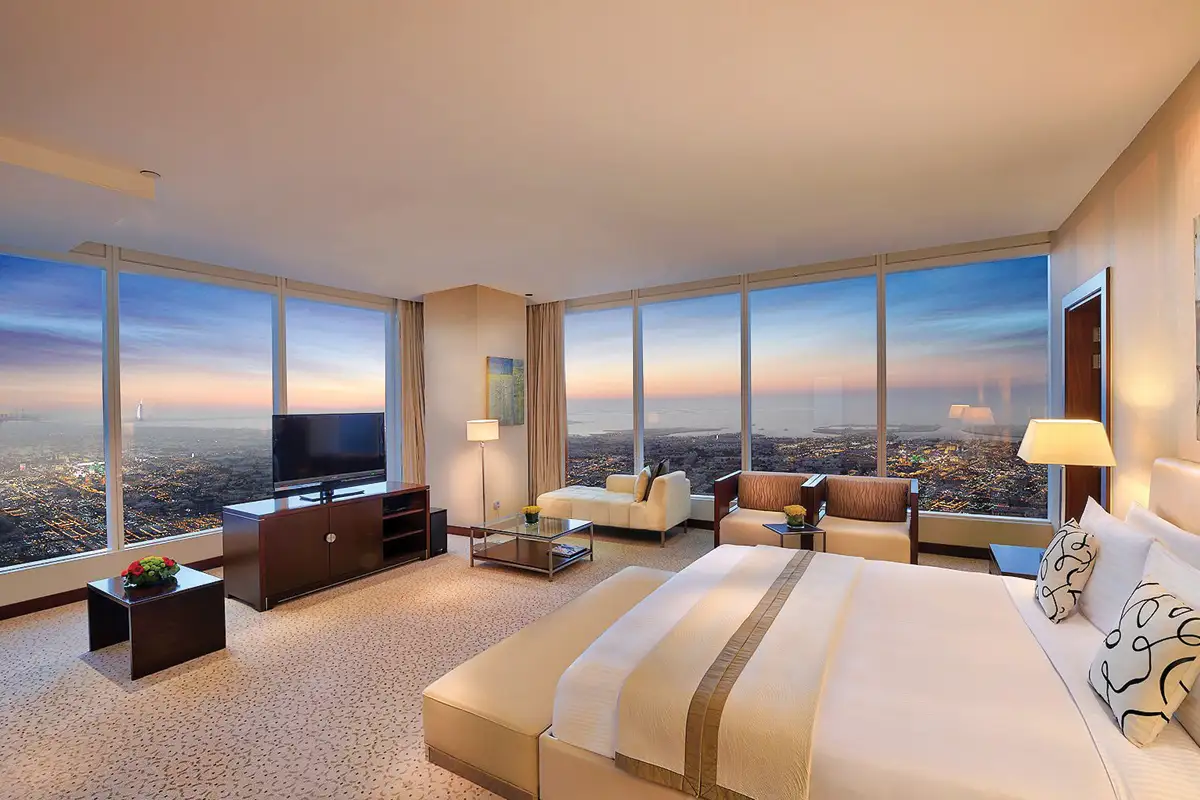
When a luxury hotel in Dubai commissions me as their interior and hotel photographer, they are not just booking someone to press a shutter. They are investing in a process — one that involves meticulous planning, precise lighting technique, hours of patient waiting, and days of careful post-production work. This particular suite image is one of the clearest examples I can point to of what that process actually looks like from start to finish.
Look at this image carefully. The room is perfectly, evenly lit — warm, inviting, luxurious. The floor-to-ceiling windows glow with the extraordinary colors of a Dubai golden hour: deep amber on the horizon, graduating to soft violet and blue sky above. You can see the Burj Al Arab standing elegantly in the far distance, the city sprawled beneath it in a carpet of lights. The bed, the furniture, the carpet, the drapes — every element sits in its own pool of warm, flattering light with no harsh shadows and no visible light sources anywhere in the frame.
None of that happened by accident. Every single detail in this image was deliberately engineered — across two full days of work.
Day One — The Shoot
Arriving at the suite early in the morning, the first task was not to pick up a camera — it was to understand the space. I walked the room for almost an hour, studying how the natural light moved through the windows at different times of day, identifying the angles that would best capture both the interior and the extraordinary view simultaneously, and planning exactly where and how each artificial light source would need to be placed.
Hotel suite photography presents a unique and demanding technical challenge: the dynamic range problem. The view outside a floor-to-ceiling window in Dubai — especially at golden hour — is many times brighter than the interior of the room. If you expose for the outside, the room becomes a dark silhouette. If you expose for the room, the windows blow out to pure white and you lose the view entirely. Neither result is acceptable for a five-star hotel brand.
The solution is a technique I have refined over many years of working as a hotel photographer across Dubai, India, Mumbai, Bengaluru, Qatar, Bahrain, Saudi Arabia, Maldives and Malaysia — and it is considerably more involved than most people realise.
The Handheld Spotlight Technique
For this shoot, I used multiple small handheld spotlights — portable, battery-powered LED panels of varying intensities — to manually illuminate every surface in the room, one area at a time. And here is the critical point that makes this technique so labour-intensive: I shot dozens of individual frames, each one with the handheld light positioned in a different location, illuminating a different section of the room from a different angle.
The bed received multiple passes — light from the left to reveal the texture of the linen, light from the right to soften the shadows on the pillows, light from slightly above to give the headboard depth without creating a harsh highlight. The furniture, the carpet, the walls, the curtains, the television unit — each one received its own dedicated lighting passes.
"Every corner of this room was hand-lit. What you see as a single seamless image is actually the result of dozens of individually lit exposures, composited together with surgical precision in post-production."
Why handheld spotlights rather than studio flash or fixed LED panels? Because handheld lights give me absolute control over the direction, quality and intensity of light on each individual surface — I can literally paint the room with light, moving the source millimeter by millimeter until the result is exactly right. Fixed panels create predictable, often flat illumination. Handheld technique creates depth, dimension and the warm, natural feeling that makes a luxury suite feel genuinely inviting in a photograph rather than clinical and staged.
You will notice something important when you look at this image: there are no visible light sources anywhere in the frame. No flash heads, no softboxes, no stands, no cables. The room appears to be lit purely by the ambient warmth of the setting sun coming through the windows — which is exactly the feeling the hotel brand wanted, and exactly what a guest would feel walking into that suite for the first time.
Achieving that requires removing every light stand and piece of equipment from the frame between every single shot — a physically demanding and time-consuming process that added hours to the shoot day.
The Golden Hour Wait
The most important element of this entire image — the extraordinary light outside the windows — required something no amount of technical skill can replace: patience.
I had tracked the sun's position and the expected quality of light for this specific suite orientation, on this specific day, weeks before the shoot. The window of time when the light outside would be at its absolute best — that precise intersection of warm golden-hour color, the Burj Al Arab visible in silhouette, and the city beginning its transition into the blue hour — was approximately 25 minutes long.
I spent most of Day One waiting for those 25 minutes.
The morning was used for test shots and equipment setup. The early afternoon for refining the interior lighting plan. The late afternoon for a final walkthrough and preparation. And then — as the sun began its descent toward the Arabian Gulf horizon — I positioned myself, set the camera to the pre-calculated exposure settings, and shot continuously through the golden hour window, capturing the room in its final composed state against the changing sky outside.
The specific frame you see here was taken at the precise peak of the golden hour — when the warm orange glow of the setting sun was at its most intense, before it shifted to the cooler tones of blue hour. Getting that timing right after an entire day of preparation is one of the most satisfying moments in hotel photography.
Day Two — The Edit
If the shoot was demanding, the post-production was equally intensive. The final image you see is the result of heavy multi-layer compositing — a technique where dozens of individual exposures are stacked and blended in post-production software to create a single final image that combines the best elements of each frame.
Each area of the room that had been individually lit during the shoot was brought into its own layer. The exposures were aligned, color-matched and then blended together using precise masking — revealing only the correctly lit portion of each frame while hiding everything else. Handheld spotlights, light stands, cables, equipment cases, and any other elements of the working environment that had accidentally appeared in frames were carefully removed.
The exterior view — captured in a separate set of bracketed exposures during the golden hour — was composited into the windows, replacing the overexposed glass with the full dynamic range of the Dubai skyline as it actually appeared at that moment.
The entire compositing and retouching process took a full second day to complete to the standard required for a five-star hotel brand's marketing materials.
Why This Level of Work Matters
A question I am sometimes asked by clients — particularly those new to commissioning professional hotel photography — is whether this level of investment in time and technique is genuinely necessary. The answer, for any luxury brand serious about how it presents itself to the world, is unambiguously yes.
Consider where this image will be used: on the hotel's website, where it may be the first impression a potential guest has of the property. In digital advertising campaigns targeting high-net-worth travellers in the UAE, UK, India and beyond. In print brochures, travel media features and OTA listings. In social media content that will be seen by tens of thousands of followers. In sales presentations to corporate clients and travel agents.
At every one of those touchpoints, the quality of the photography directly communicates the quality of the product. A mediocre image of a genuinely extraordinary suite tells potential guests that the hotel does not care enough about its own presentation to invest in showing it at its best — and that perception affects booking decisions in ways that are measurable and significant.
This is why, as a hotel and interior photographer working across Dubai, India, Mumbai, Bengaluru, Qatar, Bahrain, Saudi Arabia, Maldives and Malaysia, I approach every assignment with the same level of preparation, patience and technical rigour — regardless of whether it is a flagship suite like this one or a standard room category. Every space deserves to be shown at its absolute best.
Available for Hotel, Interior and Drone Aerial Photography
This shoot is one example of the work I deliver for hospitality and real estate clients across the region. My services include interior photography, hotel and resort photography, architectural photography, drone aerial video shooting and full content creation packages — available in Dubai, UAE, India, Mumbai, Bengaluru, Qatar, Bahrain, Saudi Arabia, Maldives, Malaysia and internationally on assignment.
If you are a hotel brand, real estate developer, interior design studio or architecture firm looking for photography that communicates the true quality of your spaces — I would love to discuss your project.